Direct answer
Direct answer
Select a crimp tool by first fixing the exact terminal MPN and production wire, then use the manufacturer’s tooling table to identify the approved applicator or hand tool, correct locator, die set, and adjustment range. Confirm that the setup controls conductor and insulation crimps separately, and qualify it with crimp-height, visual-section, pull-force, and electrical tests.
Key takeaways
- The terminal MPN—not just its family—drives tooling selection.
- Production applicators and service hand tools may have different control plans.
- A die that forms a plausible shape is not proof of a qualified crimp.
- Calibration, maintenance, and setup records matter after the first good sample.
Freeze the inputs before choosing a tool
| Input | Required detail |
|---|---|
| Terminal | Exact MPN, material, finish, barrel range, reel or loose-piece form |
| Wire | Conductor area, strand construction, insulation OD and material |
| Volume | Prototype, service, low-volume production, or automated production |
| Specification | Crimp height, width, strip length, pull force, visual limits |
| Traceability | Tool ID, calibration, applicator setup, inspection record |
Hand tool, applicator, or automated system
A manufacturer-qualified hand tool can be appropriate for prototypes, repair, and low volume when it controls terminal location and closure repeatably. A bench press or production applicator improves throughput and process monitoring. Automated cut-strip-terminate equipment adds feed, strip, crimp, and quality controls for higher volumes.
Volume alone is not the only factor. Large wire, sealed terminals, difficult locators, operator access, field service, and validation requirements can change the choice.
Why generic dies are risky
Open-barrel terminals depend on precise support of the terminal, controlled folding of conductor wings, and a separate insulation or seal-support crimp. A generic die may over-compress strands, leave wings open, crack plating, distort the locking lance, or position the seal incorrectly while still looking acceptable from one angle.
If an alternate tool must be qualified, treat it as a process-development project: measure the resulting crimp against the terminal manufacturer’s acceptance criteria rather than relying on the tool seller’s compatibility label.
Qualify the tool-wire-terminal combination
- Confirm strip length and strand condition on production wire.
- Set terminal and seal position in the applicator or locator.
- Produce samples across the intended wire and adjustment range.
- Measure crimp height and inspect cross-sections or approved visual attributes.
- Run pull-force tests and check contact retention after housing insertion.
- Measure resistance or voltage drop when electrical risk warrants it.
- Lock the setup, calibration interval, wear checks, and reaction plan.
Connect tooling to the BOM
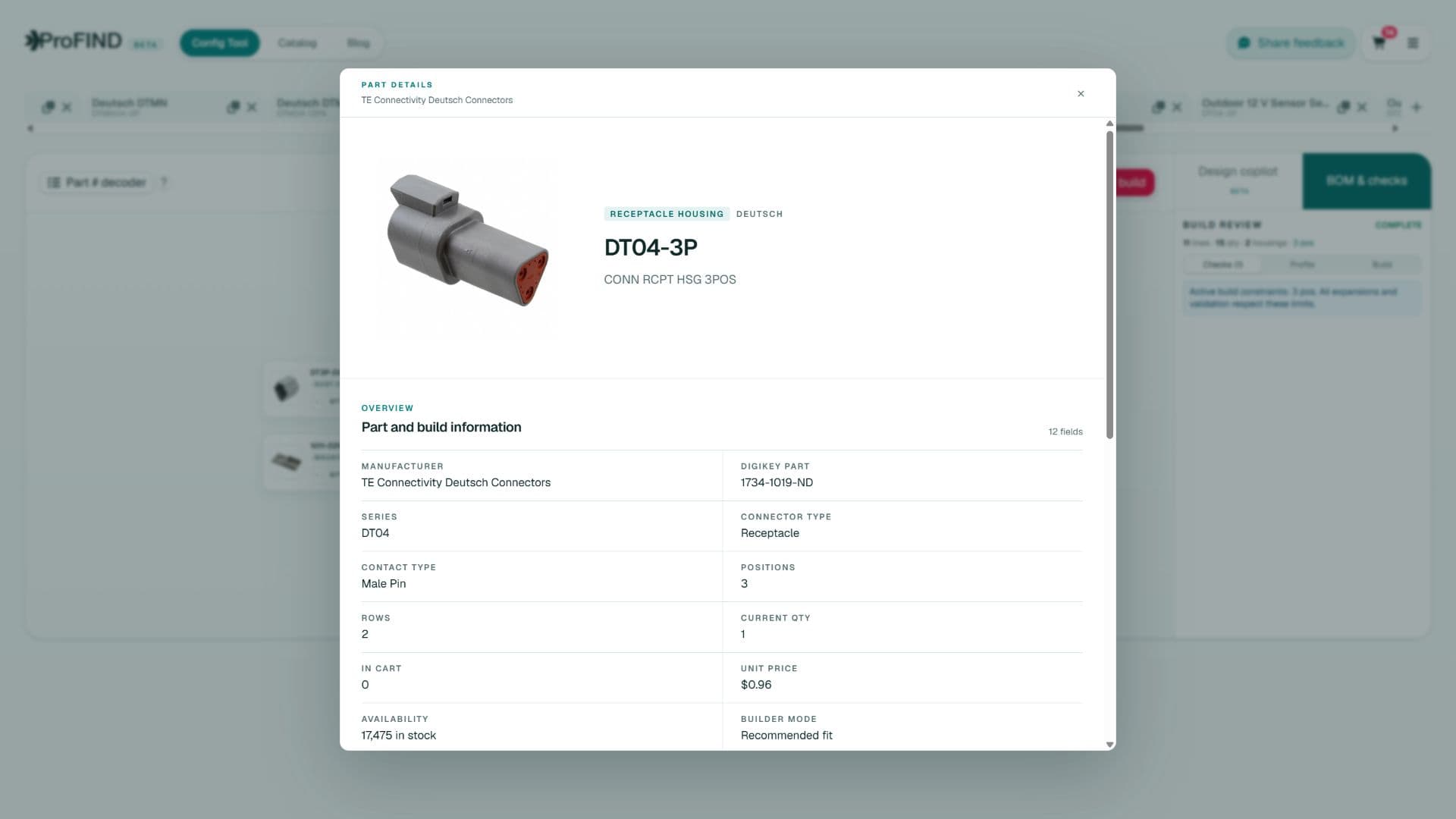
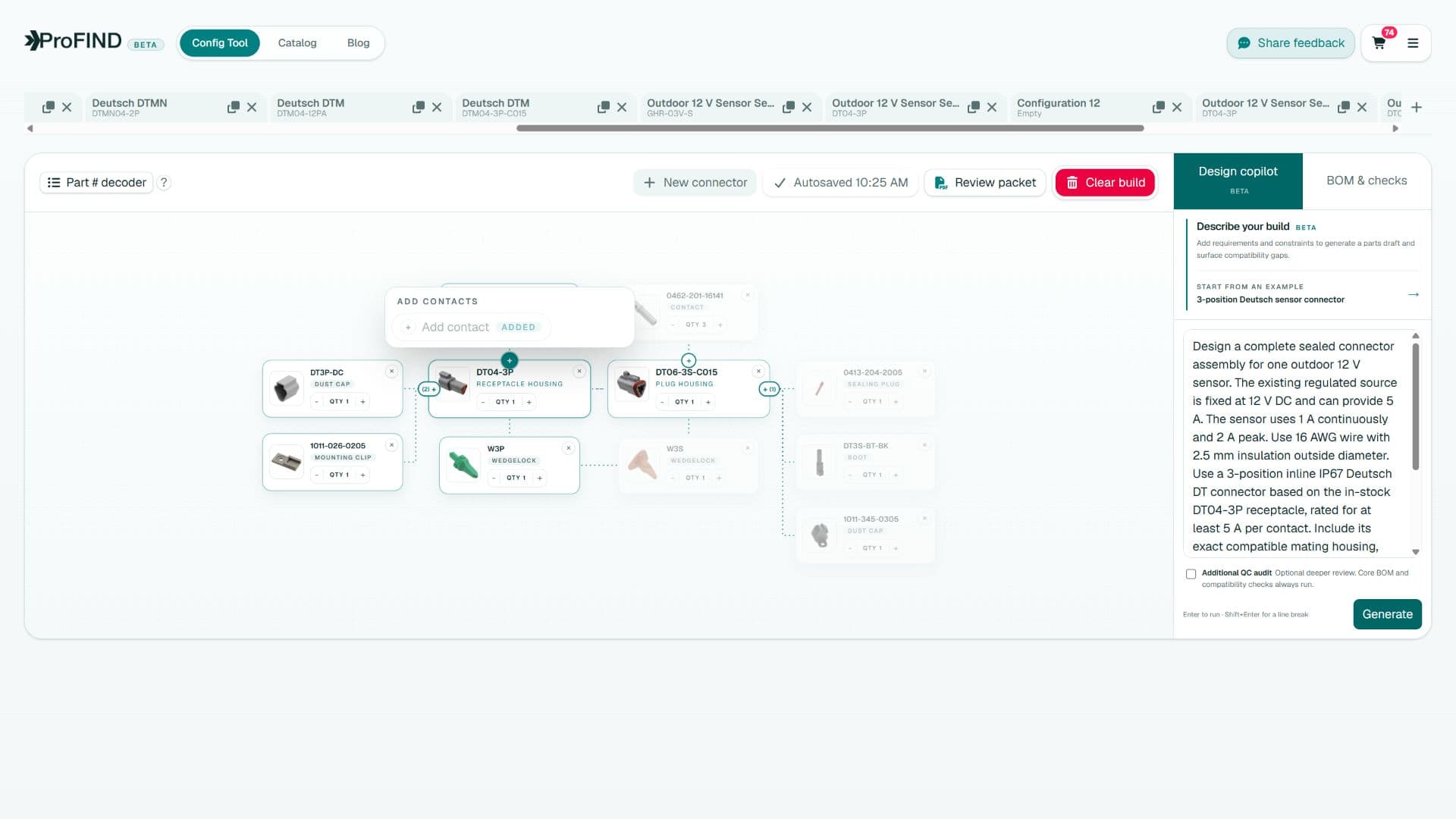
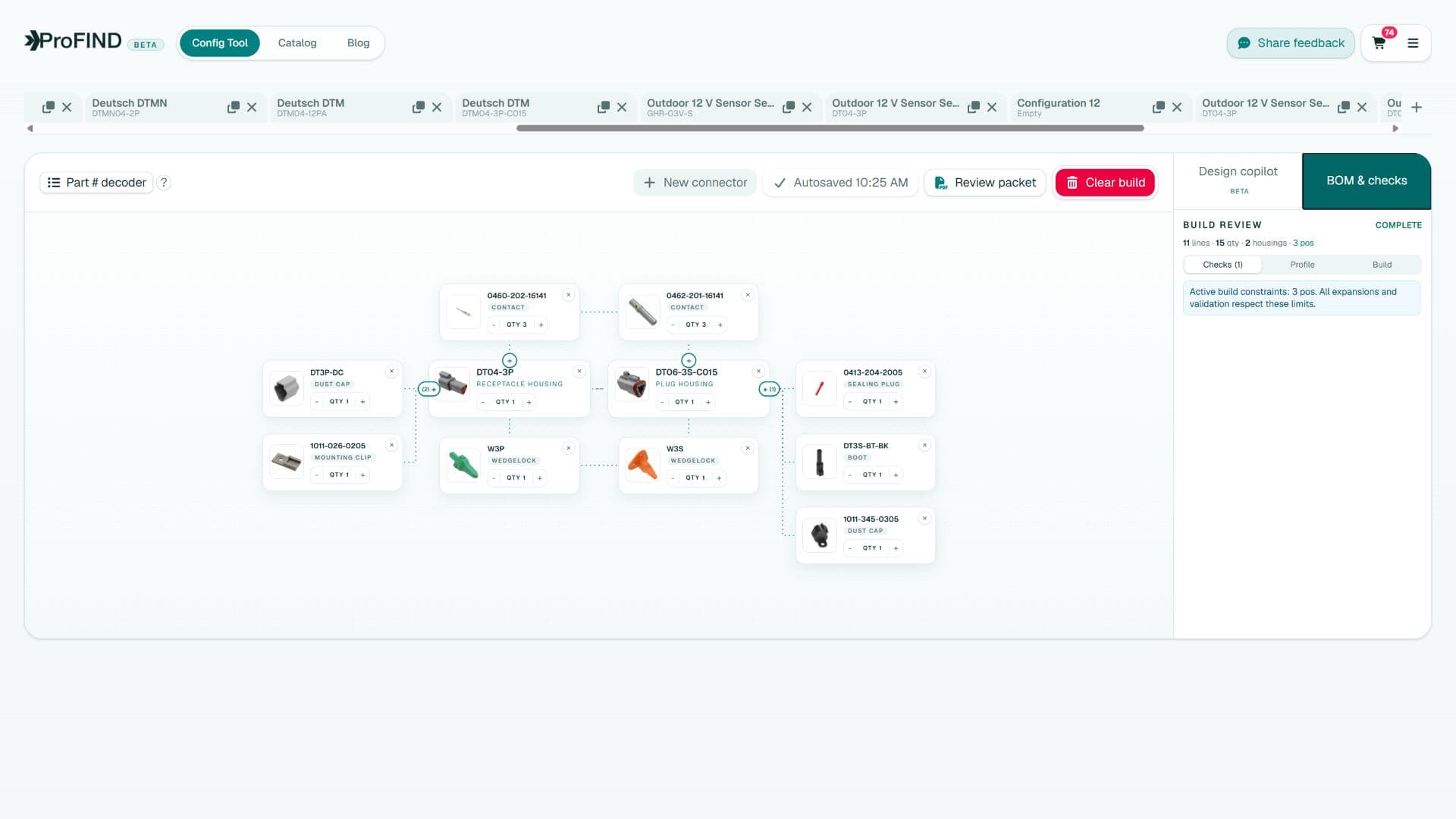
Tooling should be traceable from each terminal MPN. ProFind exposes crimp-tool and removal-tool relationships alongside the contact node, which prevents a housing-level search from suggesting a tool for the wrong terminal variant.
A correct tool is the one that produces a controlled, specification-compliant crimp on your exact terminal and wire—not the one that merely closes around it.
Quick answers
Frequently asked questions
Can one crimp tool work for many connector families?
A tool platform may accept multiple dies or applicators, but each terminal-wire combination still needs a specified setup and validation. Do not infer compatibility from family names alone.
Is a ratcheting crimper automatically better?
A ratchet can enforce a full stroke, but it does not guarantee correct die geometry, terminal location, crimp height, or wire fit.
How do I find the crimp tool for a terminal MPN?
Use the terminal manufacturer’s application specification or tooling cross-reference and match the exact terminal, wire range, and packaging form. Then verify the current tool configuration.
Engineering note
ProFind narrows choices and exposes compatibility reasoning. Always confirm the final assembly against current manufacturer drawings, application specifications, and your organization's validation process.

Written by
Parker Langlois
Founder of ProFind
Parker Langlois is an industrial designer and the founder of ProFind. He is building practical tools that turn connector selection, compatibility checks, and assembly planning into a clear, reviewable engineering workflow.