Direct answer
Direct answer
For Formula SAE, group interfaces by load, wire size, environment, packaging, and service frequency; standardize on a small number of traceable connector families; allocate unique keys where cross-connection is hazardous; qualify crimps; support the harness near every interface; and release a cavity map, BOM, spare kit, and repair procedure before testing or competition.
Key takeaways
- Standardization reduces tool, spare, training, and debugging complexity.
- High-current, low-level signal, and frequently serviced interfaces may need different families.
- Keying and harness reach should make cross-connection physically difficult or impossible.
- Competition serviceability belongs in the design, not only the paddock kit.
Classify interfaces before choosing families
| Class | Examples | Primary constraints |
|---|---|---|
| Low-level signal | Sensors, encoders, communications | EMC, shielding, contact stability |
| Control power | Relays, valves, small actuators | Transient current, vibration, sealing |
| Higher current | Pumps, fans, auxiliary feeds | Voltage drop, temperature, protection |
| Service disconnect | Removable modules and bodywork | Access, cycles, keying, labeling |
| PCB/device | ECU and sensor headers | Fixed interface, strain relief, sealing |
Standardize deliberately
Pick the smallest family set that covers the circuit classes without forcing incompatible wire or current ranges. Standardization lets the team buy fewer crimp tools, carry useful spares, teach one assembly process, and recognize faults quickly. But do not push high-current feeds through a signal-focused family or oversize every sensor connector for visual consistency.
Freeze manufacturer MPNs and finishes. An anonymous “Deutsch-style” or “waterproof automotive” kit can undermine the whole standardization strategy because its contacts, seals, and tools are not traceable.
Design against the competition failure modes
- Vibration and cable motion at unsupported connector exits
- Water or cleaner entering unsealed or unmated interfaces
- Sensor and actuator connectors swapped during rapid service
- Marginal crimps from generic tools or inexperienced operators
- Harness abrasion against chassis, powertrain, or bodywork
- Unlabeled cavities and undocumented mid-season wiring changes
Build and verify production-intent harness samples
- Train operators on strip, crimp, insertion, lock, and inspection criteria.
- Perform first-off crimp measurements and pull tests for each terminal-wire combination.
- Check every cavity against the released pin map and run continuity/short tests.
- Load-test higher-current paths and record voltage drop.
- Shake, flex, wet, heat, and service representative assemblies before the car relies on them.
- Capture failure photos and update work instructions while the evidence is fresh.
Use a live connector system map
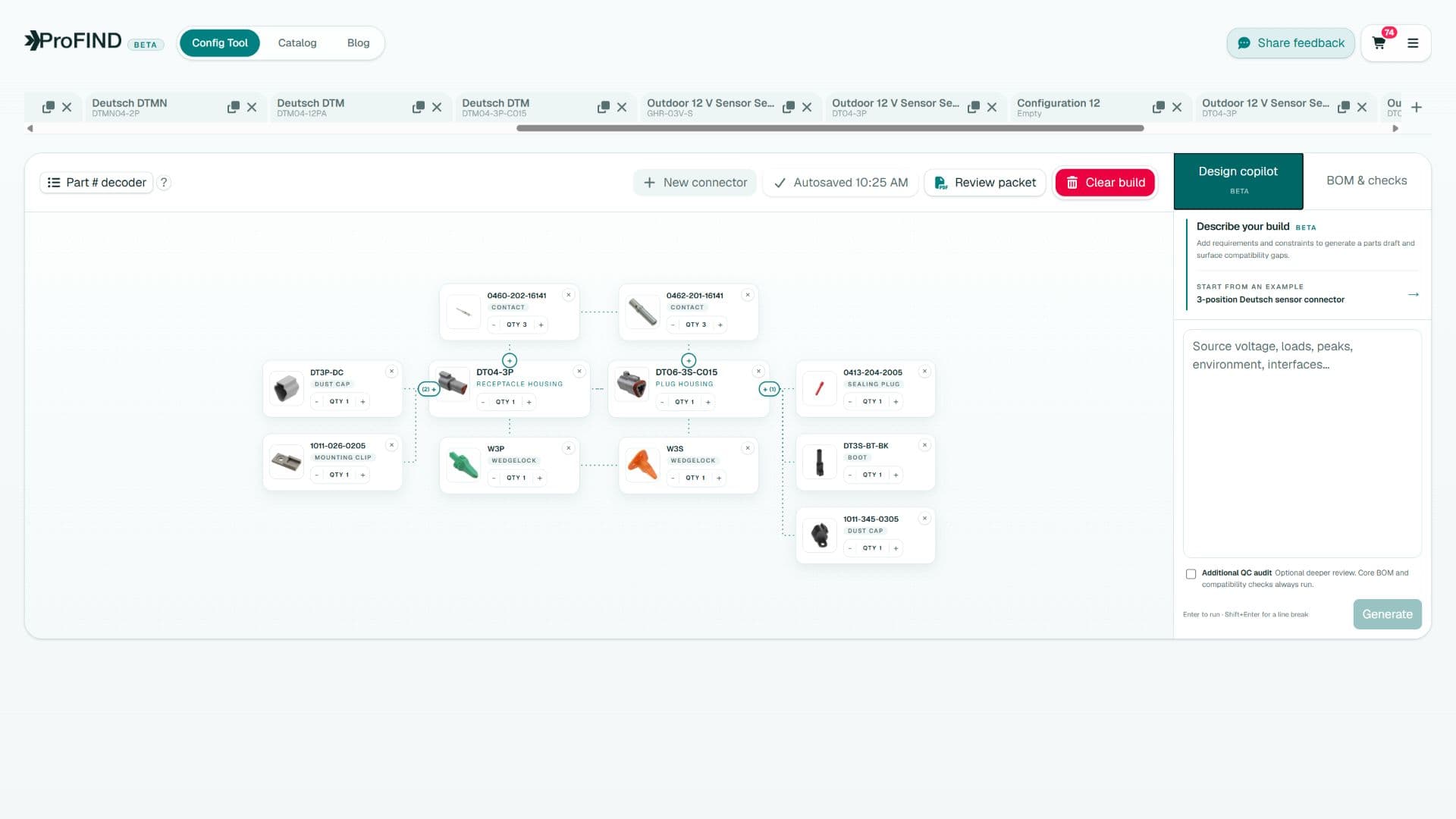
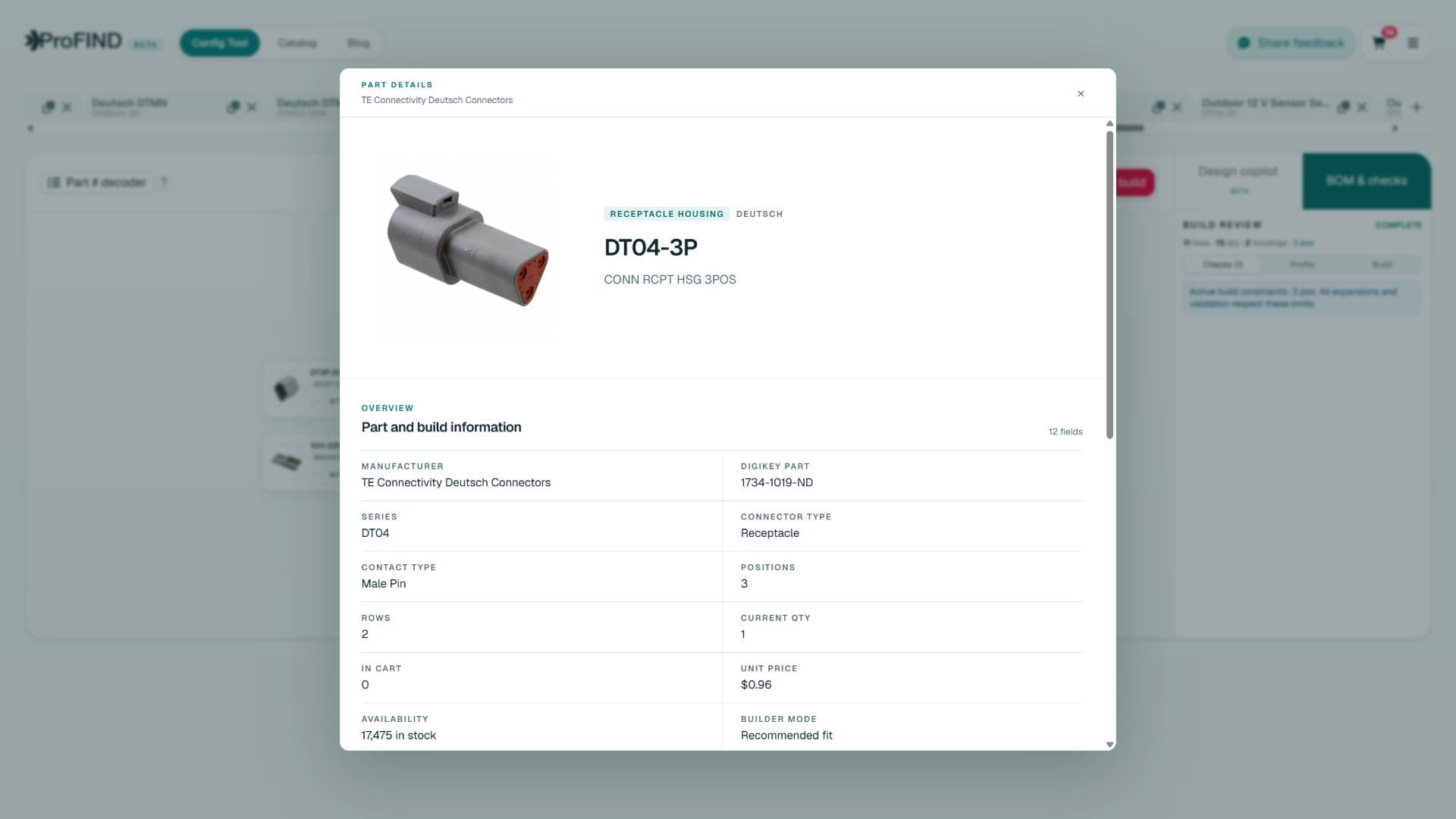
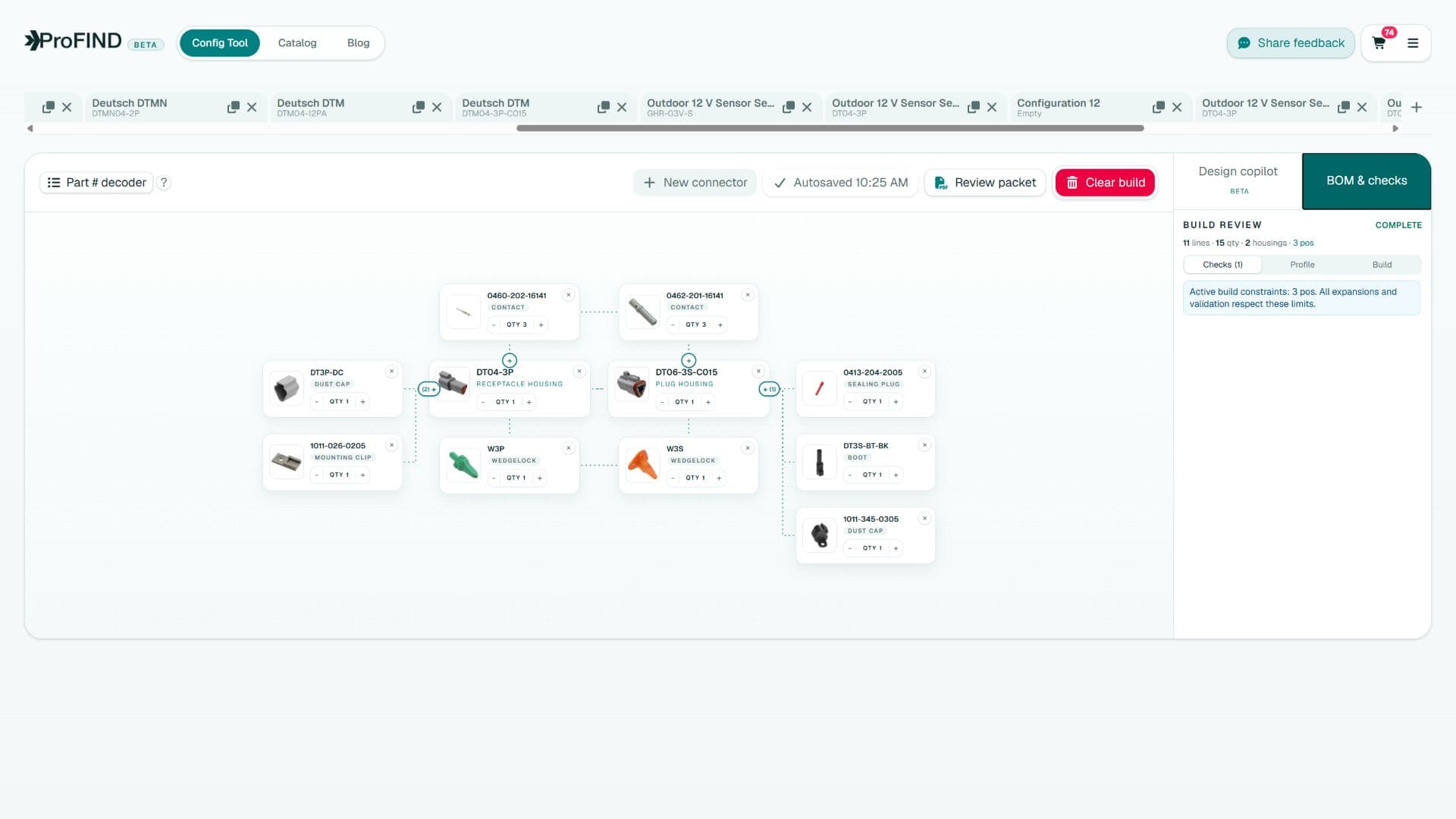
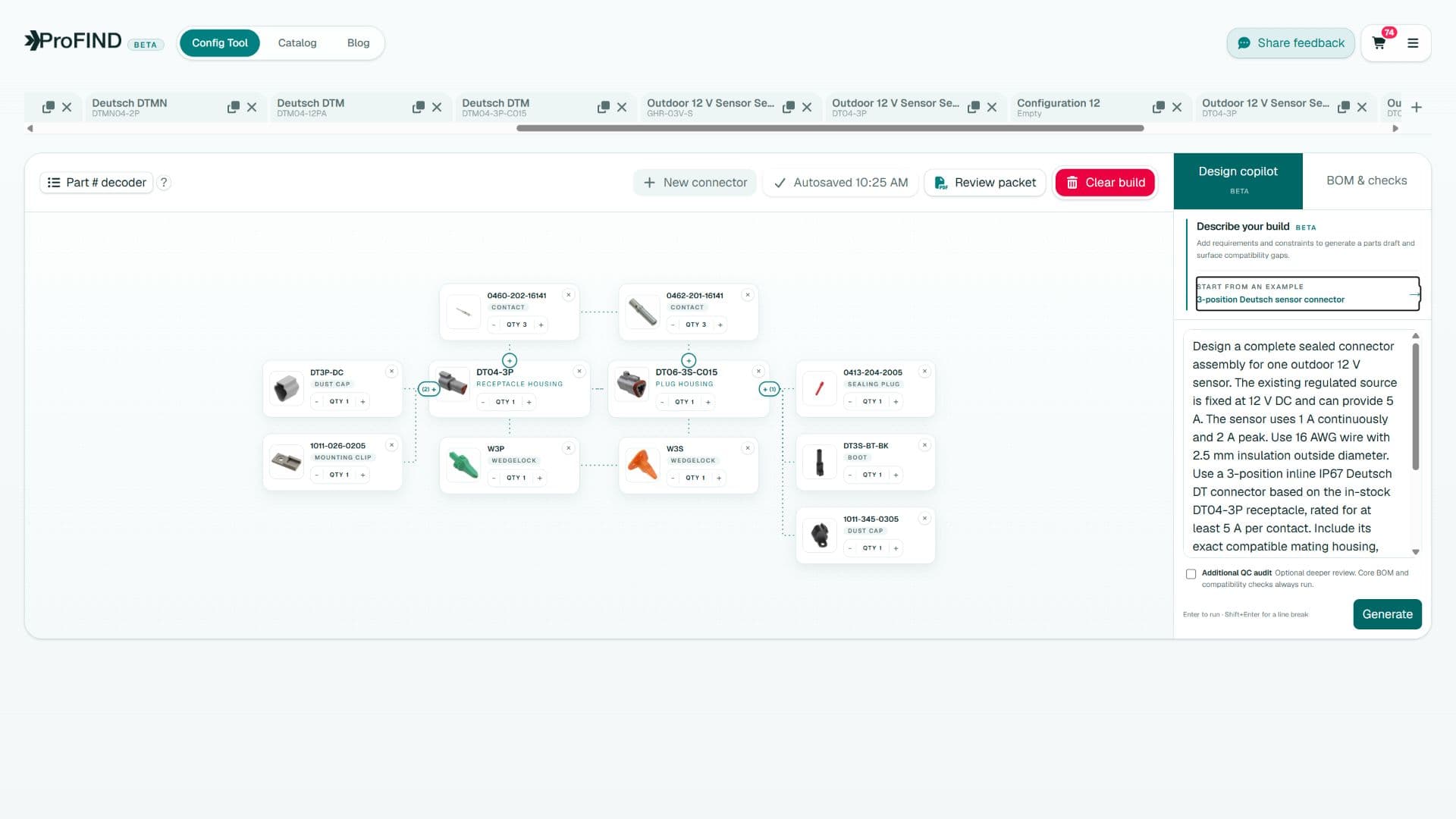
Build each interface in ProFind as a graph, then use the configuration as the source for its connector BOM. Design Copilot can create a starting configuration from requirements, while the node builder lets electrical and mechanical members inspect the actual parts and relationships together.
Create a competition spare set from the released graph: mated housings, contacts, seals, locks, cavity plugs, extraction tools, and a compact crimp solution appropriate to field repairs.
If the car cannot be diagnosed and repaired from the cavity map and spare kit under time pressure, the interface is not competition-ready.
Quick answers
Frequently asked questions
Should a Formula SAE team use one connector family everywhere?
Standardize on as few families as practical, but let load, wire, shielding, packaging, and service requirements justify exceptions.
How can a student team prevent connectors being swapped?
Use complementary unique key variants, different cavity counts or families, controlled harness reach, clear labels, and a deliberate mismating review.
What connector spares should go to competition?
Carry traceable housings, terminals, seals, locks, plugs, extraction and crimp tooling, wire, labels, cavity maps, and known-good completed subassemblies for critical interfaces.
Engineering note
ProFind narrows choices and exposes compatibility reasoning. Always confirm the final assembly against current manufacturer drawings, application specifications, and your organization's validation process.

Written by
Parker Langlois
Founder of ProFind
Parker Langlois is an industrial designer and the founder of ProFind. He is building practical tools that turn connector selection, compatibility checks, and assembly planning into a clear, reviewable engineering workflow.